
Classic Homemade Aubergine Parmigiana: Traditional Recipe
There are recipes that cannot be improvised, aubergine parmigiana is one of them.
It requires a few extra steps — from preparing the aubergines to frying, and finally baking — but each phase contributes to building a rich, fragrant, and flavourful dish.
At first glance, it might seem challenging, but in reality, there’s only one moment that requires a little more attention: frying the aubergines. Once you’ve got that done, the rest becomes almost a pleasure.
It’s simply about creating layers, one on top of the other, alternating ingredients until the baking dish is filled, forming a parmigiana that’s golden on top and soft inside.
By organising the steps well, you can prepare it stress-free, even on the weekend, perhaps by dividing the work into two sessions.
What you need before you start
Before you begin, I recommend preparing all the necessary items: having everything to hand makes the preparation much simpler and mishap-free.
For this recipe, you’ll need a few well-chosen tools: a deep dish for soaking the aubergines, a chopping board and a sharp knife for even slices, a large frying pan for frying, and a plate with flour for dusting them.
Also, have some kitchen paper ready to absorb excess oil after frying, and a baking dish with fairly high sides (about 5–10 cm), ideal for creating layers without difficulty.
How to cook aubergine parmigiana
🛒 Ingredients
400g tomato passata (approx. 1 can)
1 cup plain flour (plus more if needed)
3 eggs
approx. 500ml frying oil
2 fresh mozzarella balls (fior di latte)
100g grated Parmesan cheese
salt to taste
👩🍳 Instructions
Wash the aubergines thoroughly under running water and slice them into 1cm thick slices.
Transfer the slices to a large bowl filled with water, add a heaped tablespoon of salt, and stir gently with your hands to distribute it. Cover the aubergines with a plate to keep them completely submerged in water. Let them rest for about 1 hour.
This is an important step, as slices left out of the water tend to darken.
This step is precisely to eliminate any bitterness from the aubergines and make them ‘sweeter’ after cooking.


After soaking, drain the aubergines and lay the slices on kitchen paper without rubbing them, so that excess water is absorbed naturally.
This step is crucial for achieving dry and golden-fried aubergines.


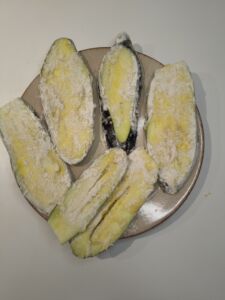
Meanwhile, prepare two bowls: in one, beat the eggs with a pinch of salt; in the other, put the flour for dusting. Take one aubergine slice at a time and dip it first in the egg, on both sides, then in the flour, again on both sides.
As you prepare them, place them on a plate, well spaced apart, without overlapping.
Important tip: work in small batches of 5–6 slices at a time.
This way, the coating remains dry, adheres better, and won’t become damp or come off during frying.
I prefer to proceed like this: I prepare a small first batch, fry it, and while it’s cooking, I prepare the next ones. It’s a slower method, but it guarantees a much more stable and crisp result.


Heat plenty of frying oil in a large pan. When the oil is very hot, fry a few slices at a time to avoid lowering the temperature and to ensure even browning.
Turn the slices during cooking until they are golden brown on both sides.


Then, lift them with a fork or kitchen tongs and transfer them directly onto kitchen paper. Lay them flat without overlapping so they lose excess oil and remain drier and lighter.
This step is important to keep the parmigiana lighter and well-balanced. The final calorie count of the recipe can vary precisely based on the amount of oil absorbed during frying.


Spread a couple of tablespoons of tomato passata on the bottom of the baking dish, just enough to prevent the aubergines from sticking. Arrange the first layer of fried aubergines, making sure to cover the entire surface well.
On top of the aubergines, add 2–3 tablespoons of tomato passata, some pieces of mozzarella, and a sprinkle of grated Parmesan.


Keep going until you’ve used up all the ingredients. Generally, you’ll get about 3 layers, depending on the size of your baking dish.
For the final layer, cover everything with the tomato passata, without adding mozzarella, and finish with a generous sprinkle of Parmesan and a thin drizzle of extra virgin olive oil.
In this case, I used tomato pulp directly without preparing a separate sauce: this makes the recipe simpler and quicker while still maintaining an excellent result.


Preheat the oven to 180°C using the static setting. Place the parmigiana in the middle shelf and bake for about 25–30 minutes, until a thin golden crust forms on top.
Once cooked, remove the parmigiana from the oven and let it rest for at least 15–20 minutes before serving: this step is important to allow the layers to set and make cutting easier.


In qualità di Affiliato Amazon potrei ricevere un guadagno dagli acquisti idonei, acquista attraverso il mio Blog per aiutarmi.


Variations of Aubergine Parmigiana
Aubergine parmigiana lends itself to various variations, depending on your taste and the desired outcome.
If you prefer a lighter version, you can choose to grill the aubergines instead of frying them. The result will be less rich but still tasty, especially if you pair it with a simple tomato passata and slightly reduce the amount of cheese.
For a richer and more stringy version, you can replace the mozzarella with provola or scamorza, which melt better in the oven and make the dish even creamier.
Finally, if you want to make the parmigiana even more flavourful, you can add a mix of Parmesan and Pecorino, which gives a stronger and more characteristic note to the final result. Adding a few fresh basil leaves between the layers can also provide a more intense and traditional aroma.
Frequently Asked Questions
How do you store aubergine parmigiana?
Aubergine parmigiana should be stored in the refrigerator in an airtight container for about 2–3 days.
Before serving, it’s advisable to reheat it in the oven or on the hob to regain its original texture and flavour.
Can it be prepared in advance?
Yes, in fact, it tastes even better the next day.
Resting allows the layers to set and the flavours to meld better.
How do you reheat it without ruining it?
The best way is in the oven at 160–170°C for about 10–15 minutes, covered with foil to prevent the top from drying out.


