
Sugar? It’s not just… sugar! (Meaning: not just that!)
Sometimes we tend to oversimplify and think that sugar is simply that little pile of white grains we put in our coffee in the morning.
In reality, that’s not quite right.
In the kitchen, sugar is a bit like a wild card: sometimes it’s used to sweeten, but other times it works “behind the scenes”. In fact, it allows us to make a cake incredibly soft or to give a golden crispiness that’s impossible to resist.
I’d like to enter the world of sugars with you and discover together that every recipe has its ideal partner.
Undoubtedly, classic granulated sugar is the undisputed king of our pantries because it can be bought anywhere, and it’s reliable and neutral.
It’s what makes our cakes rise and our creams frothy, but it’s not the only star in sweet cooking.
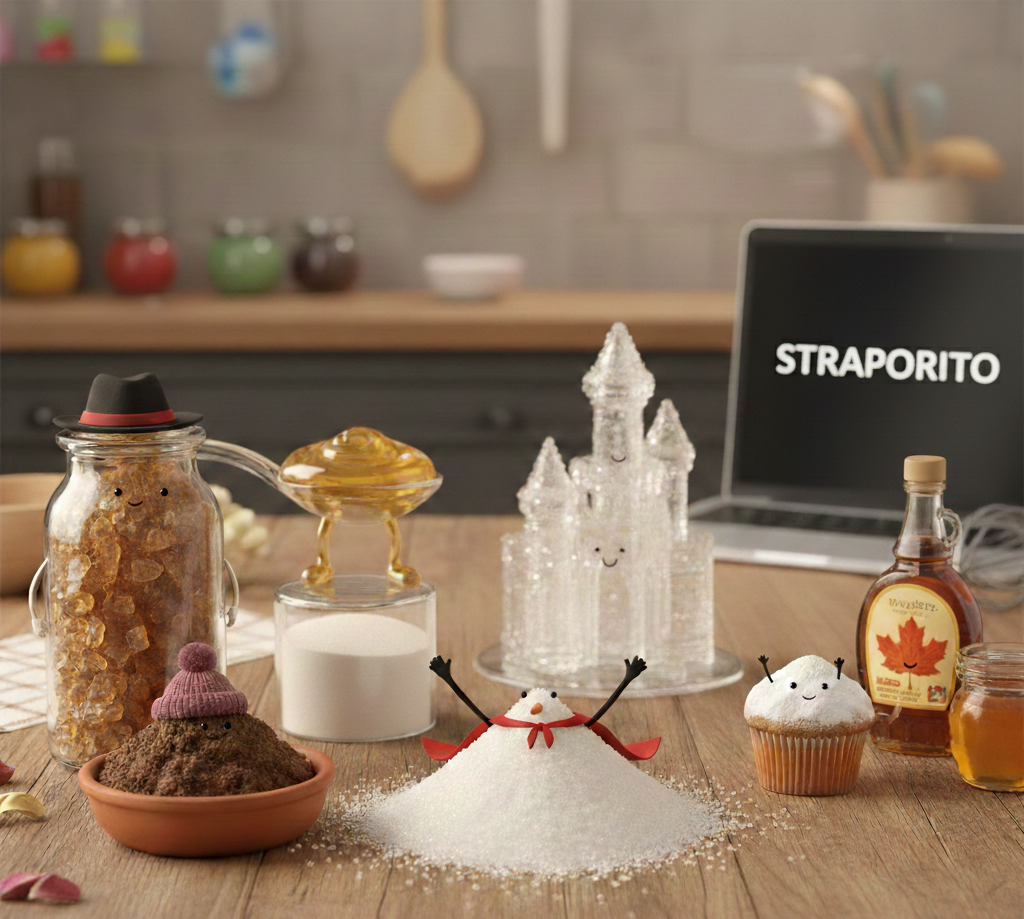
From cane sugar to molasses: a journey of flavours
If we move towards less refined versions, we encounter raw cane sugar, which with its amber crystals gives a slight hint of caramel.
But the real magic happens when you taste Muscovado.
It’s not the usual dark sugar you find at the café; it’s moist, dense, and in my opinion, has an aroma reminiscent of liquorice and dates.
Using it in a brownie or a chocolate biscuit completely changes the outcome: you won’t just get sweetness, but an almost “molten” texture and an aroma that will fill the whole house.
The secrets you won’t find in the supermarket (but that chefs love)
In the kitchens of great pastry chefs, however, we go further.
I imagine you know those shiny glazes that look like mirrors, or ice creams that remain creamy even after hours in the freezer. In reality, you should know that the credit goes to so-called “technical” sugars like glucose or dextrose.
Glucose is a sort of dense syrup that prevents sugar from becoming grainy, keeping everything elastic and shiny.
Dextrose, on the other hand, is the best friend of cold: it sweetens less than normal white sugar, but it prevents the formation of annoying ice crystals.
And for those who really want to go all out with decorations, there’s isomalt: the artist’s sugar, perfect for creating transparent and resistant decorations that look like they’re made of glass.
Nature gets involved: honey and syrups as sugar
Let’s not forget, however, that nature offers us spectacular alternatives.
Honey, for example, is a true master of preservation.
Being able to retain moisture, it will ensure that the breakfast bundt cake remains soft for many more days than one made only with granulated sugar.
Maple syrup, on the other hand, isn’t just for Sunday pancakes: try it to caramelise baked carrots or pumpkin and you’ll see an explosion of flavour!
What sugar should be used for diabetic biscuits?
I cannot and do not want to answer questions like these because they are sensitive topics that must be addressed by true health experts.
For this reason, on this topic, I recommend you read this interesting article I found on the Fondazione Veronesi website.


As an Amazon Affiliate, I may earn a commission from qualifying purchases. Please purchase through my blog to help me out.
But where can these ingredients be found?
While granulated sugar and honey are everywhere, for the more technical gems, you need to know where to look.
Muscovado can be found in the organic or fair-trade sections of large supermarkets.
For glucose or isomalt, on the other hand, the advice is to take a look online on websites specialising in pastry: for a few pounds, you can get your hands on the tools to transform a homemade cake into a small pastry masterpiece.
After all, cooking is precisely this: understanding that even a simple ingredient like sugar can hide a thousand different nuances.
Next time you’re making a dessert, try changing the crystals… the result might surprise you!


